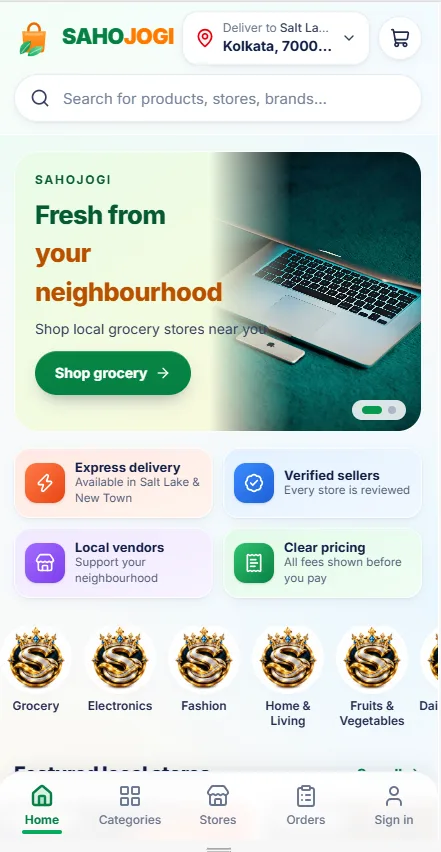
About the Project
SAHOJOGI is a modern multi-vendor e-commerce marketplace built around the idea of Shop Local • Support Together. The platform aims to connect customers with local businesses while enabling vendors to manage their online stores, products, inventory, orders, and sales through a unified digital ecosystem.
Designed with a clean, warm, mobile-first interface, SAHOJOGI combines local shopping experiences with nationwide e-commerce capabilities, creating a flexible foundation for a diverse range of products and businesses.
Key Features
Multi-Vendor Marketplace
A centralized shopping platform with individual vendor storefronts, product catalogs, category-based browsing, inventory management, and vendor-specific order processing.
Customer Shopping Experience
An intuitive interface for discovering products, exploring stores, managing a shopping cart, checking out, viewing order history, and tracking order progress.
Role-Based Management Panels
Separate, permission-controlled interfaces for Super Admin, Vendors, Delivery Agents, and Customers, connected through a shared backend.
Hybrid Delivery Management
Support for area-based grocery, food, vegetable, and snack services alongside eligible nationwide products such as electronics, fashion, and furniture.
Inventory and Order Management
Product availability, vendor order processing, order status updates, delivery assignments, and order-history management.
Platform Administration
Centralized management of users, vendors, categories, products, stores, delivery settings, platform configurations, and operational workflows.
Business and Financial Operations
The broader platform roadmap includes configurable vendor commissions, delivery-agent earnings, COD reconciliation, settlement management, return and refund workflows, membership benefits, customer reward points, influencer referrals, and GST reporting.
UI/UX and Technology
SAHOJOGI follows a mobile-first design approach with glossy pastel backgrounds, fresh green and warm orange accents, rounded cards, clear navigation, and responsive layouts optimized for mobile browsers, tablets, and desktop screens.
The web platform uses React and TypeScript for the frontend, Node.js and Express for the backend, MongoDB for persistent data, and Redis for caching and background processing.
Project Objective
The objective is to establish a flexible, scalable marketplace that helps independent vendors participate in digital commerce, makes shopping straightforward for customers, and provides centralized tools for managing commerce and fulfillment operations.
Development Status
The platform is under active development, with ongoing work focused on extending business workflows, refining the mobile experience, strengthening financial controls, and validating end-to-end functionality. Production performance figures and business outcomes will be published only when verified data is available.
Client name
SAHOJOGI — In-house Marketplace Project
Industry
E-Commerce & Retail Technology
Challenge & objectives
Build a unified multi-vendor e-commerce platform capable of supporting multiple independent vendors, diverse product categories, customer shopping, vendor operations, and delivery management. The platform must accommodate local delivery restrictions for eligible grocery and food products while supporting nationwide shipping for eligible non-local products. The primary objective is to provide a user-friendly mobile shopping experience with centralized administration and configurable business rules.
Solution & implementation
Developed a React-based responsive storefront connected to a Node.js and Express backend, MongoDB database, and Redis infrastructure. The platform is organized into four role-based web panels: Customer, Vendor, Delivery Agent, and Super Admin. The implementation focuses on reusable UI components, product and store discovery, shopping and checkout workflows, role-based access control, order management, and extensible modules for fulfillment and financial operations.
Results & outcomes (verified only)
The current project establishes the foundation for a multi-vendor marketplace with a responsive customer-shopping experience and separate operational interfaces. Quantitative outcomes such as sales growth, conversion improvements, delivery performance, and production load capacity have not been independently verified and are not claimed.